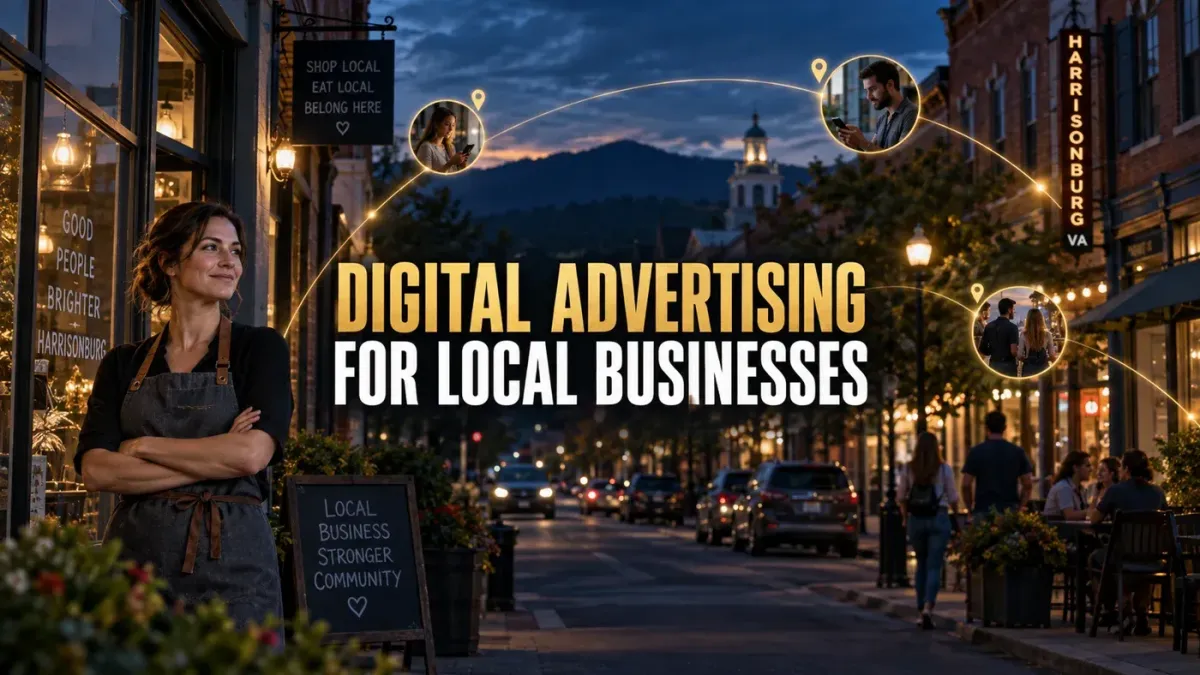
How Digital Advertising Actually Works for Local Businesses
Digital advertising helps local businesses reach the right people before, during, and after they decide where to spend their money.
But it is not as simple as showing an ad to everyone within a few miles. Effective digital advertising combines audience strategy, location data, persuasive messaging, conversion paths, follow-up, and measurement. Each part has to support the next.
For a business in Harrisonburg or elsewhere in the Shenandoah Valley, that can mean reaching nearby residents, commuters, visitors, business decision-makers, or people who have recently shown interest in a relevant service. The goal is not to create the largest possible audience. It is to create useful exposure among the people most likely to become customers.
WHAT IS DIGITAL ADVERTISING FOR A LOCAL BUSINESS?
Digital advertising is the paid distribution of messages across websites, apps, social platforms, and other digital media. A local business uses it to reach people based on factors such as geography, interests, behavior, demographics, content consumption, or prior interaction with the business.
Unlike a traditional billboard or broad print placement, digital advertising can use different messages for different audiences and measure what happens after an ad is delivered. That makes it possible to learn which combinations of audience, message, offer, and conversion path create qualified opportunities.
Digital advertising for local businesses may include:
- Paid social advertising on Facebook, Instagram, LinkedIn, Pinterest, and X
- Geofencing and location-based advertising
- Programmatic display and video advertising
- Retargeting people who previously visited a website or landing page
- Audience sequencing that changes the message as familiarity grows
These tactics are most effective when they operate as parts of one customer acquisition system rather than isolated campaigns.
HOW DOES DIGITAL ADVERTISING WORK?
Most digital advertising follows a five-part process: define the audience, deliver a relevant message, direct interested people to a conversion path, follow up with qualified leads, and connect the results to revenue.
1. THE BUSINESS DEFINES WHO SHOULD SEE THE MESSAGE
The first decision is not which platform to use. It is which customer the business wants to attract.
A useful audience definition considers location, customer needs, buying triggers, service fit, value, and readiness. A Harrisonburg home-services company might focus on homeowners within a realistic service radius. A professional firm may need to reach owners or executives across Rockingham County and the broader Shenandoah Valley. A retailer may care about people who live nearby, visit a competing location, or regularly travel through a specific commercial area.
The strongest targeting begins with an Exact-Fit Customer: someone who can afford the service, is willing to invest, can get a strong result, and is a pleasure to serve. Clear targeting reduces wasted reach and gives the message a specific person to address.
2. THE AD EARNS ATTENTION WITH A RELEVANT MESSAGE
Local customers scroll past hundreds of messages every day. An ad has to communicate relevance quickly.
Strong local advertising usually identifies a recognizable problem, creates a reason to keep reading or watching, and presents a credible next step. It should sound like the customer, not like a generic corporate announcement.
Specificity matters. “We offer quality service” gives the audience little reason to respond. A message built around a costly delay, frustrating situation, desired outcome, or timely local need gives the right prospect a reason to pay attention.
Good advertising also filters. A precise message helps qualified prospects recognize themselves while allowing poor-fit prospects to move on. That protects the business from paying for attention that is unlikely to produce revenue.
3. THE PLATFORM DELIVERS THE AD
Digital advertising platforms use auctions and delivery systems to decide which ads appear, to whom, and how often. Cost and delivery can be influenced by audience size, competition, placement, creative quality, campaign goal, timing, and the likelihood that a person will take the intended action.
This is why the lowest cost per click or lowest cost per thousand impressions is not automatically the best result. A cheaper audience that produces no qualified customers can be more expensive than a higher-cost audience that closes consistently.
The platform optimizes toward the signal it receives. If a campaign is designed and measured around shallow activity, it may generate more shallow activity. If the system sends reliable information about qualified leads and customers, the business can make decisions based on outcomes that matter.
4. THE LANDING EXPERIENCE CONTINUES THE CONVERSATION
When someone responds to an ad, the destination should match the promise that earned the click.
A focused landing page explains the offer, establishes trust, addresses common concerns, and provides one clear next step. That action may be calling, requesting an estimate, booking a consultation, scheduling a visit, or completing a qualification form.
Sending every campaign to a generic homepage often creates unnecessary friction. The visitor has to search for the information that was already relevant enough to earn attention. A dedicated conversion path keeps the message consistent and makes action easier.
For local businesses, useful trust signals can include customer reviews, recognizable service areas, relevant project examples, team credentials, response expectations, and a clear explanation of what happens after the inquiry.
5. FOLLOW-UP TURNS INTEREST INTO OPPORTUNITY
An ad does not create revenue by itself. It creates an opportunity for the business to continue the conversation.
Every inquiry should enter a defined lead-management process. The business should know the source, campaign, requested service, assigned owner, current status, and next action. Immediate confirmation can reassure the prospect that the request was received, but human follow-up should happen quickly when the buying intent is high.
Consistent follow-up matters because local buyers frequently contact more than one provider. The business that responds clearly, answers the right questions, and makes the next step easy has an advantage.
WHAT DO THE MAJOR DIGITAL ADVERTISING TACTICS DO?
PAID SOCIAL ADVERTISING
Paid social distributes ads through platforms such as Facebook, Instagram, LinkedIn, Pinterest, and X. It can introduce a business to new audiences, promote a timely offer, build familiarity, and reconnect with people who have already engaged.
Its strength is the ability to combine audience selection with visual storytelling and repeated exposure. The creative and offer must still be strong. Targeting cannot rescue a message that gives the audience no reason to care.
Geofencing and Location-Based Advertising
Geofencing creates a virtual boundary around a real-world location. Depending on the campaign and available inventory, a business can use location-based advertising to reach people connected to relevant places, such as commercial districts, events, competitor locations, or service areas.
This can be valuable when physical location is a meaningful indicator of customer intent. It should be used strategically and responsibly, with sensible frequency and a message that makes sense for the audience.
PROGRAMMATIC ADVERTISING
Programmatic advertising uses technology to buy and place digital ads across a broad range of websites, apps, streaming environments, and other inventory. It can extend reach beyond a single social platform and support more precise audience or geographic strategies.
Programmatic campaigns work best with clear audience logic, controlled placements, strong creative, frequency management, and measurement that goes beyond impressions.
RETARGETING AND AUDIENCE SEQUENCING
Most people do not become customers after one exposure. Retargeting allows a business to reconnect with people who visited a page, watched content, or interacted with a campaign.
Audience sequencing takes this further by changing the message over time. A first ad may introduce a problem. A later ad may explain the process. Another may present proof, answer an objection, or invite action. This creates a more useful journey than repeatedly showing the same ad.
HOW DIGITAL ADVERTISING SUPPORTS THE FIVE-STAGE FUNNEL
AWARENESS
Paid social, programmatic advertising, and location-based campaigns introduce the business to exact-fit prospects who may not know it yet.
INTEREST
Educational creative, useful content, video, testimonials, and retargeting help people understand the problem and the business's approach.
INTENT
Specific offers, focused landing pages, FAQs, case studies, and audience sequencing help qualified prospects evaluate whether to take the next step.
PURCHASE
Fast follow-up, clear sales communication, simple scheduling, and consistent lead management turn qualified interest into customers.
ADVOCACY
A strong customer experience creates reviews, referrals, repeat purchases, and stories that improve future advertising.
When advertising supports all five stages, the business is less dependent on one ad producing an immediate sale. Each campaign has a clear role in moving the right people forward.
HOW SHOULD A LOCAL BUSINESS MEASURE DIGITAL ADVERTISING?
Digital advertising should be measured as a business system, not a collection of platform statistics.
Impressions, video views, clicks, and cost per click can help diagnose delivery, but they do not prove profitable growth. Local businesses should connect campaign activity to meaningful outcomes such as:
- Qualified leads by source and campaign
- Landing-page conversion rate
- Speed to first response
- Appointment or estimate rate
- Show rate
- Close rate
- Customer acquisition cost
- Revenue and gross margin by source
- Repeat purchase and referral activity
The best campaign is not necessarily the one that generates the most leads. It is the one that produces the right customers at economics the business can sustain.
COMMON REASONS LOCAL DIGITAL ADVERTISING FAILS
Digital advertising usually underperforms because of a system problem, not because local customers somehow ignore every digital channel.
Common causes include:
- Targeting an audience that is too broad or poorly qualified
- Using generic creative that sounds like every competitor
- Promoting a weak or unclear offer
- Sending traffic to a homepage that does not continue the message
- Failing to track calls, forms, appointments, and closed business
- Responding too slowly to inquiries
- Showing the same ad too often without sequencing or refreshing it
- Optimizing for cheap clicks or lead volume instead of customer quality
- Increasing the budget before fixing conversion or follow-up
More spending amplifies the system that already exists. It does not repair a broken handoff.
HOW MUCH SHOULD A LOCAL BUSINESS SPEND?
There is no responsible universal budget. The right investment depends on customer value, gross margin, sales-cycle length, market size, campaign objective, creative needs, conversion rate, close rate, and the amount of data required to make a useful decision.
Start with the economics. Estimate what a new customer is worth, how many qualified opportunities are needed to produce one customer, and what acquisition cost the business can support. Then choose a budget that can create enough reach and conversion volume to evaluate the strategy.
A budget spread thinly across too many audiences and tactics may never produce a clear signal. A focused campaign with a defined audience, offer, conversion path, and measurement plan is usually a stronger starting point.
BUILD DIGITAL ADVERTISING AROUND THE CUSTOMER JOURNEY
Digital advertising works when the right people receive a relevant message, encounter a clear next step, receive timely follow-up, and move through a measurable customer journey.
For businesses in Harrisonburg, Rockingham County, and across the Shenandoah Valley, local knowledge can sharpen the geography and message. But the same principle applies nationwide: advertising should be connected to a complete acquisition system, not treated as an isolated source of clicks.
Funnel Force builds marketing systems built to scale for established businesses locally and nationwide. Our approach connects paid social, geofencing, programmatic advertising, retargeting, audience sequencing, conversion paths, CRM strategy, and full-funnel measurement.
The goal is not more digital activity. It is measurable growth from a system the business can understand and improve.
FREQUENTLY ASKED QUESTIONS
WHAT IS THE BEST TYPE OF DIGITAL ADVERTISING FOR A LOCAL BUSINESS?
There is no single best tactic. The right choice depends on the exact-fit customer, service area, buying behavior, urgency, customer value, sales cycle, and available creative. Many local businesses benefit from a focused combination of paid social, geofencing, programmatic advertising, retargeting, and audience sequencing.
HOW LONG DOES DIGITAL ADVERTISING TAKE TO WORK?
Some campaigns can generate inquiries quickly, but reliable evaluation takes enough time and volume to assess lead quality, conversion, sales follow-up, and closed revenue. Businesses with longer sales cycles need more time before judging customer acquisition results.
DOES GEOFENCING WORK FOR SMALL BUSINESSES?
Geofencing can work when visits to specific places are a meaningful signal of customer fit or intent. Success depends on location selection, audience size, creative relevance, frequency, conversion strategy, and measurement. It should be one tactic within a broader advertising system.
WHAT IS THE DIFFERENCE BETWEEN RETARGETING AND AUDIENCE SEQUENCING?
Retargeting reconnects with people who previously interacted with the business. Audience sequencing deliberately changes the message based on where those people are in the journey, helping them move from awareness to interest, intent, purchase, and advocacy.
HOW CAN A BUSINESS TELL WHETHER DIGITAL ADS ARE PROFITABLE?
Connect each campaign to qualified leads, appointments, closed customers, revenue, gross margin, and customer acquisition cost. Platform metrics can explain delivery, but profitability depends on the business outcomes produced after the click or impression.